
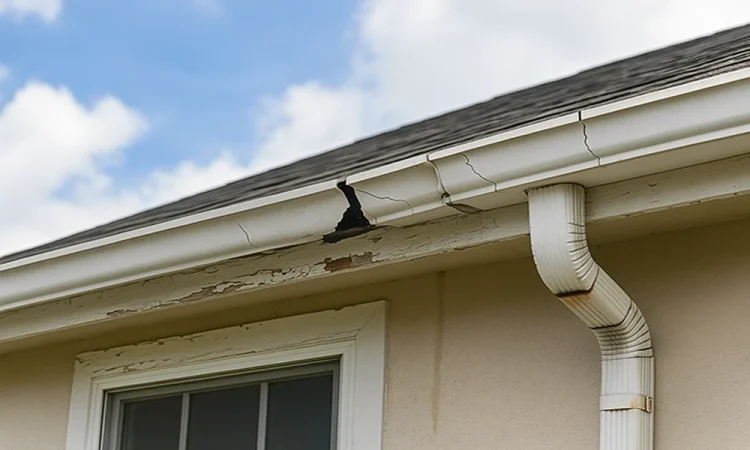
The storm rolls in on a Tuesday evening, and within ten minutes water is pouring over the front gutter in a solid sheet, drilling a trench into the flower bed right where the porch meets the foundation. The gutter was cleaned in spring. It isn’t clogged. It has simply stopped doing its job, and that difference is what separates a Saturday chore from a real project.
Homeowners weighing a Kettering gutter replacement often live in houses built as the city filled out in the decades after World War II, many still wearing their second or third set of gutters, under the same big maples and oaks that were saplings when the neighborhood was new. Those houses, those trees and the freeze and thaw of a Miami Valley winter shape almost every decision that follows.
The Tells That Show Up Before the Leak
Gutters rarely fail all at once. They send signals for a season or two, and most of them are visible from the driveway or the backyard.
- Sagging sections that dip between hangers, which let water pool and freeze in winter.
- Drips at the corners and end caps, where sealant has dried out and pulled away from the metal.
- Spike heads backing out of the fascia, a sign the wood behind them has softened.
- Peeling paint or dark water lines on the siding directly below the gutter.
- Rust spots or pinholes, common on older galvanized steel runs.
- A damp basement corner that lines up with a downspout outside.
One of these alone may call for a repair. Three or four together usually mean the system has reached the end.
Patching Buys Time, Until It Doesn’t
A leaking joint can be resealed. A loose hanger can be swapped out. The trouble is that sectional gutters, the kind sold in ten foot lengths, have a joint every ten feet, and each one ages at the same pace. Fixing one seam tends to reveal the next.
Age is a useful guide. Aluminum gutters often last around twenty years or more with reasonable care, while older steel systems tend to rust through sooner. If the gutters are original to a remodel from decades ago, and repairs are becoming a yearly ritual, the money spent on patches starts to look better spent on a new system.
What Comes Off the House Says a Lot
The most revealing part of a replacement is the moment the old gutter is pulled down. The fascia board behind it has spent years in the path of any overflow, and rot often hides there completely out of sight. Good installers probe the wood before hanging anything new, because fresh gutters screwed into soft fascia will sag within a few winters.
This is also when the drip edge gets a look. That thin strip of metal along the roof edge should direct water into the gutter rather than behind it. If it’s missing or bent, adding or correcting it now costs far less than dealing with stained soffits later.
Choosing Metal, Shape and Size for an Ohio Winter
Seamless aluminum dominates residential work for good reason. It’s formed on site from a continuous coil, cut to the exact length of each wall, and the only joints are at corners and downspout outlets. It doesn’t rust, it holds paint well, and it comes in dozens of colors to match trim.
Thickness deserves a question when collecting quotes. Heavier gauge aluminum, often listed as .032 inch, resists dents from ladders and falling limbs better than thinner .027 stock. Vinyl costs less up front but grows brittle in hard cold and can crack when ice builds up. Copper and half round profiles suit older or historic homes but cost considerably more.
Size matters more than most people expect. A standard five inch K-style gutter handles many homes, but steep roofs, long runs and big valleys dumping into one corner often need six inch gutters paired with larger three by four inch downspouts. Wider downspouts also clog far less often with the seeds and twigs that come down from mature trees.
Hanger style and spacing round out the picture. Old spike and ferrule systems loosen as the wood expands and contracts. Hidden hangers fastened with screws, spaced roughly every two feet, hold much better under the weight of snow and ice.
The Part Hidden Under the Lawn
Many older homes route downspouts into buried pipes that carry water to the street or a far corner of the yard. Those underground lines are easy to forget, and they clog with roots, sediment and packed leaves. A brand new gutter feeding a blocked pipe will still back up and overflow.
A simple test before replacement helps. Run a garden hose into the downspout opening at ground level and see whether water flows freely or backs up. If it backs up, the buried line needs clearing or rerouting, or the downspout needs a surface extension that carries water several feet away from the foundation instead.
Leaves, Seeds and the Screen Question
A tree canopy that shades the house in July fills the gutters in October and again in May when maple seeds drop. Replacement is the easiest moment to add guards, since they can be sized and fitted to the new system from the start. Fine mesh styles block the smallest debris, while simpler perforated covers handle large leaves but let seeds through. Neither makes gutters maintenance free, though both stretch the time between cleanings.
The Week After the Crew Leaves
A typical home can be completed in a day, but the real inspection happens during the first good rain. Walk the perimeter while it’s coming down and watch a few specific things.
- Every corner and end cap should stay dry on the outside.
- Water should reach each downspout rather than pooling mid-run.
- Downspout outlets should discharge well clear of the foundation.
Any drip or puddle spotted in that first storm is an easy adjustment while the work is fresh. After that, a cleaning in late fall and a look after major storms is usually all a well-built system asks for, and the flower bed by the porch finally gets to stay where it was planted.